Health Screening

Alexis Facto • December 16, 2025

The words "health testing" are thrown around a lot and often not accurately...


And what is bred with H.E.A.R.T., OFA, and CHIC?

  • Bred With H.E.A.R.T.

    AKC created their own program to recognize breeders who uphold the following values...


    H - Health: a breeder is certifying that their breeding stock are health tested in accordance with their breed's parent club


    E - Education: a breeder's promise to pursue coninuing education and remain up to date on breeding practices and advances in canine health


    A - Accountability: an agreement to comply with AKC's care and conditions policy on the proper housing, care, and treatment of your animals and to readily comply with AKC inspections. As well as  to share health testing results.


    R - Responsibility:  Accepting responsibility for the health and well-being of the puppies you produce and for complying with all laws regarding the ownership and maintenance of dogs.


    T- Tradition: Upholding the AKC’s tradition of breeding purebred dogs that are happy and healthy.


  • Orthopedic Foundation for Animals (OFA)

    The OFA is a database and certifying official for various types of health screenings. The OFA organizes and stores all of the results from dogs whose health testing has been submitted for certification. The goal is to make results publically available for breeding decisions so that ultimately we can create healthier dogs. 


    Any dog with an OFA number or CHIC number can be searched by anyone who chooses to do so  in their database!


    For certain exams they also have certifying officials that 'grade' radiographs based on what is visualized. Dachshunds don't have these exams as apart of their health screening.


  • Canine Health Information Center (CHIC)

    From the OFA website about CHIC: 


    The OFA created the Canine Health Information Center (CHIC) by partnering with participating parent clubs to research and maintain information on the health issues prevalent in specific breeds. We’ve established a recommended protocol for breed-specific health screenings. Dogs tested in accordance with that protocol are recognized with a CHIC number and certification.


    At OFA, we recognize that the more information stored and accessible in these databases, the better it will be for every breed. And so we encourage all breeders to attain CHIC Certification if their breed participates in the CHIC program.


    A dog achieves CHIC Certification if it has been screened for every disease recommended by the parent club for that breed and those results are publicly available in the database.
           Each dog breed has a different set of criteria for testing depending on what ailments they commonly suffer from. The organizations that set these guidelines are each breed's own parent club--for Dachshunds this is the Dachshund Club of America (DCA).

           One misconception is that registries, like American Kennel Club (AKC), set these guidelines--but their responsibility is just carrying out what the breed club states for things like conformation and health testing. It's the DCA that says piebald dapples aren't breed standard, that miniature is 11 lbs and under at 12 months old, and that Dachshunds forequarters should be strong, deep, and well muscled.

           What AKC did do is create their own program that highlights breeders who prioritize these screenings & continuing education by starting the bred with H.E.A.R.T. program.


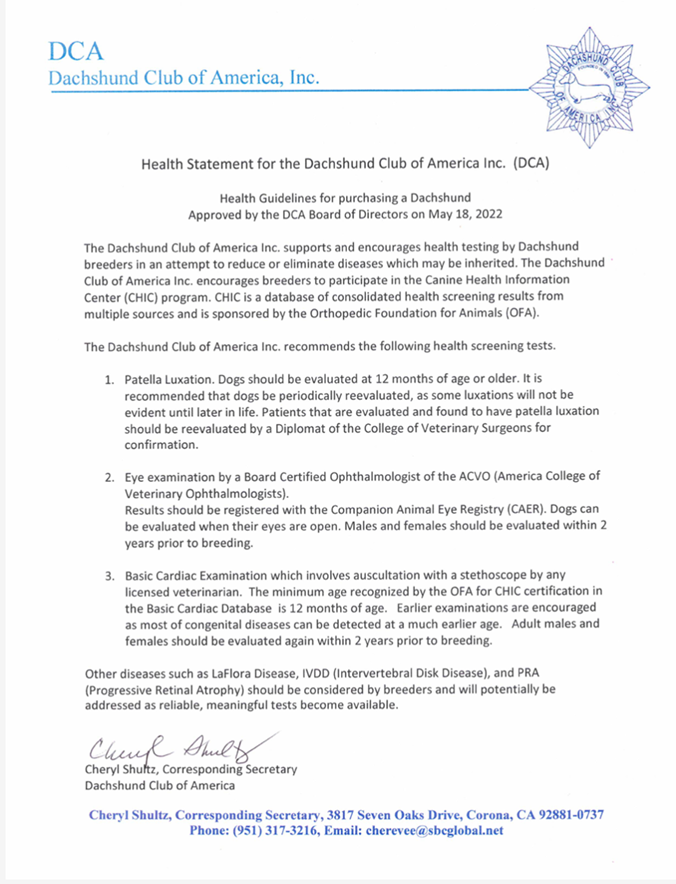
So what does the DCA say about health screening (testing)?


They recommend (as they cannot really demand) the following:

Patella Luxation Exam (knee caps)

Eye Exam (CAER) by an vet-ophthalmologist

Basic Cardiac Exam


There are additional mentions of genetic conditions but not a formal call to action for breeders and shockingly no mention of breeding a dapple to dapple, maybe it's so unethical that is should be commonly understood?

The takeaway as a puppy buyer:


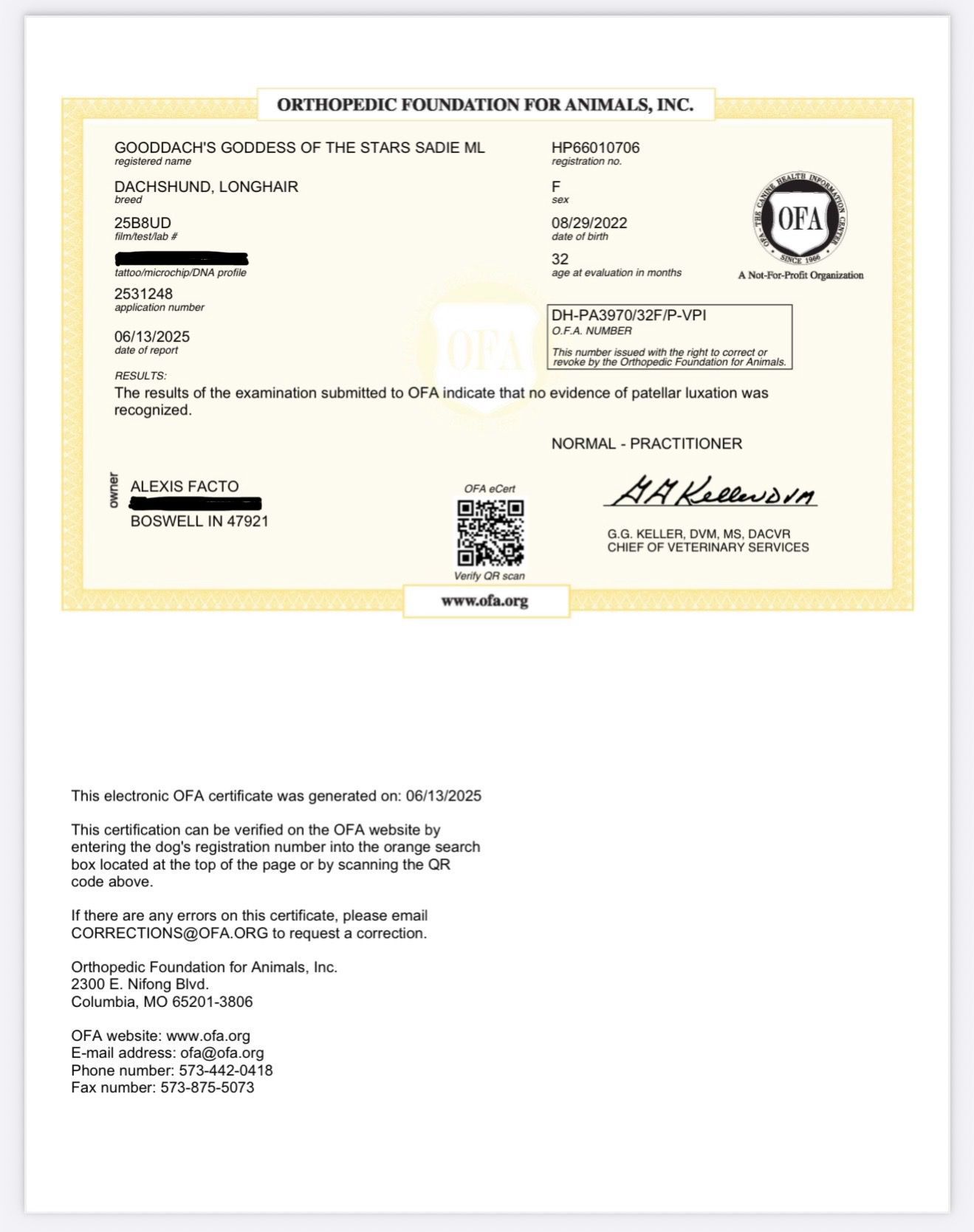
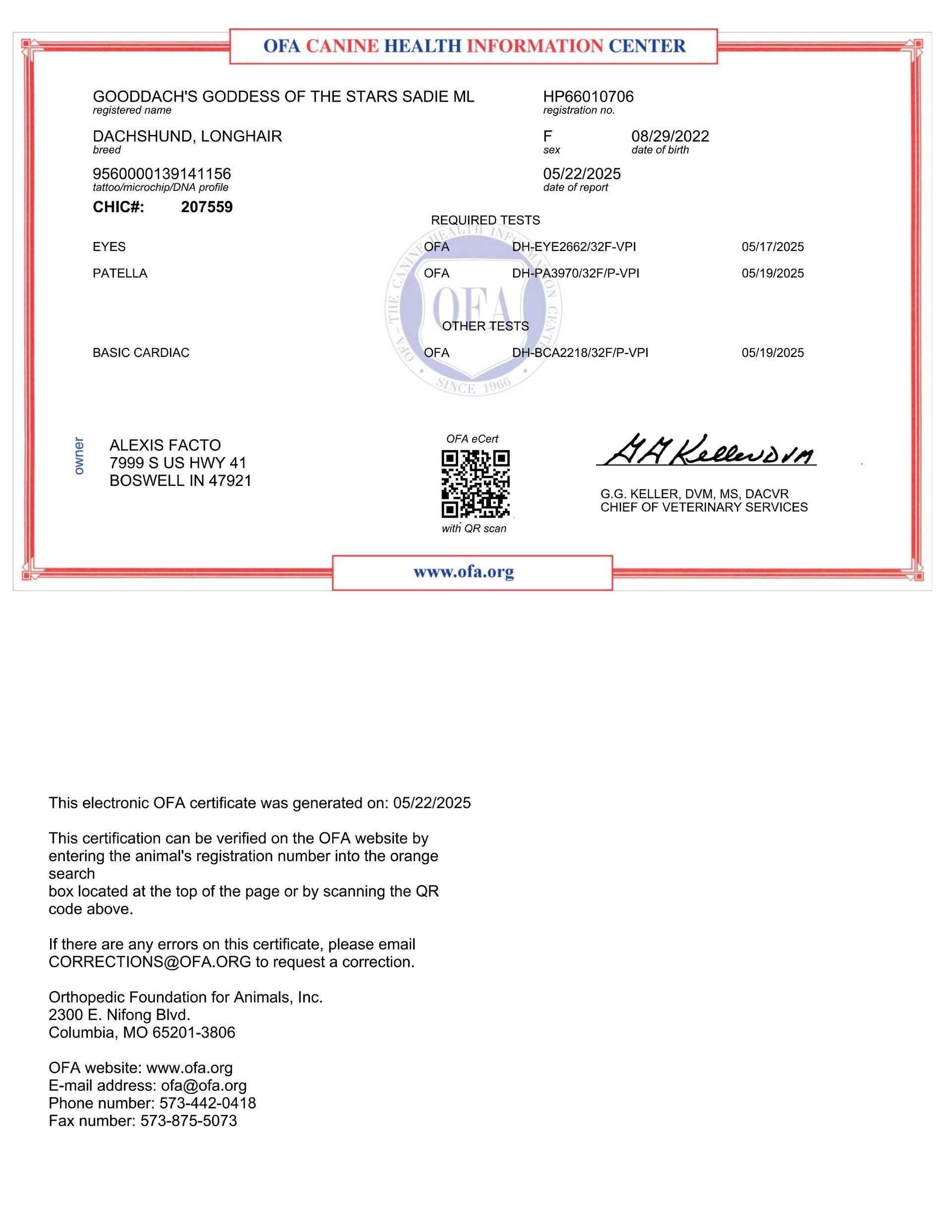
     If you're searching for a puppy and want one from fully health tested parents look for the AKC Bred with H.E.A.R.T. certificate and get PROOF in the form of OFA and CHIC numbers or certificates to confirm what the breeder is claiming (examples of CHIC certificates and OFA certificates shown below). AKC doesn't check to see if these breeders who request bred with H.E.A.R.T. actually are. I've inquired about a number of puppies for our own program and have found breeder's with this claim who do not meet the standards.

     If you'd like to go a step farther go to the OFA website and search these numbers to confirm that the certificates are true & not altered. There are breeders who have created fakes--terrible fakes if you know what the real ones look like, but still fake and beyond unethical.
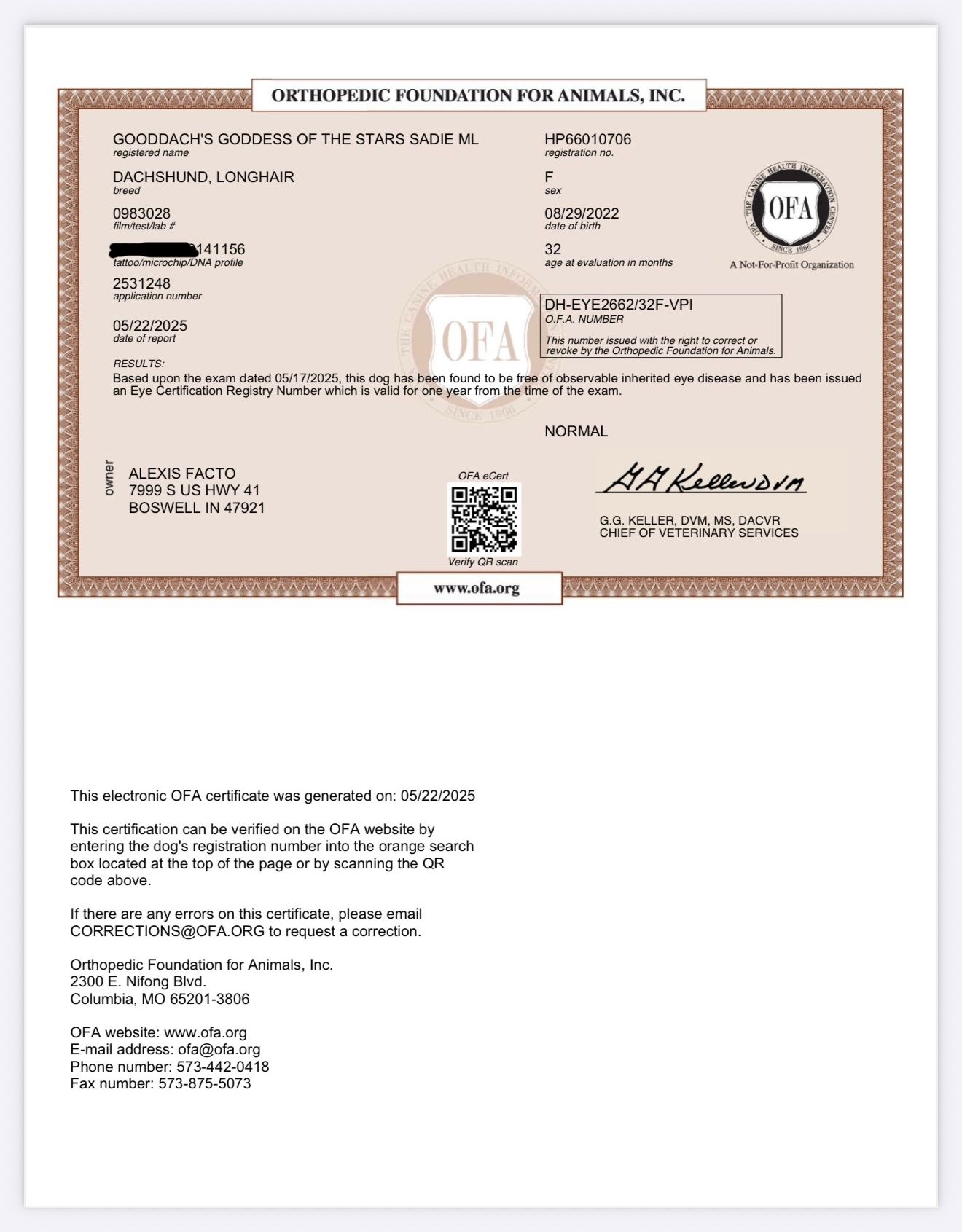
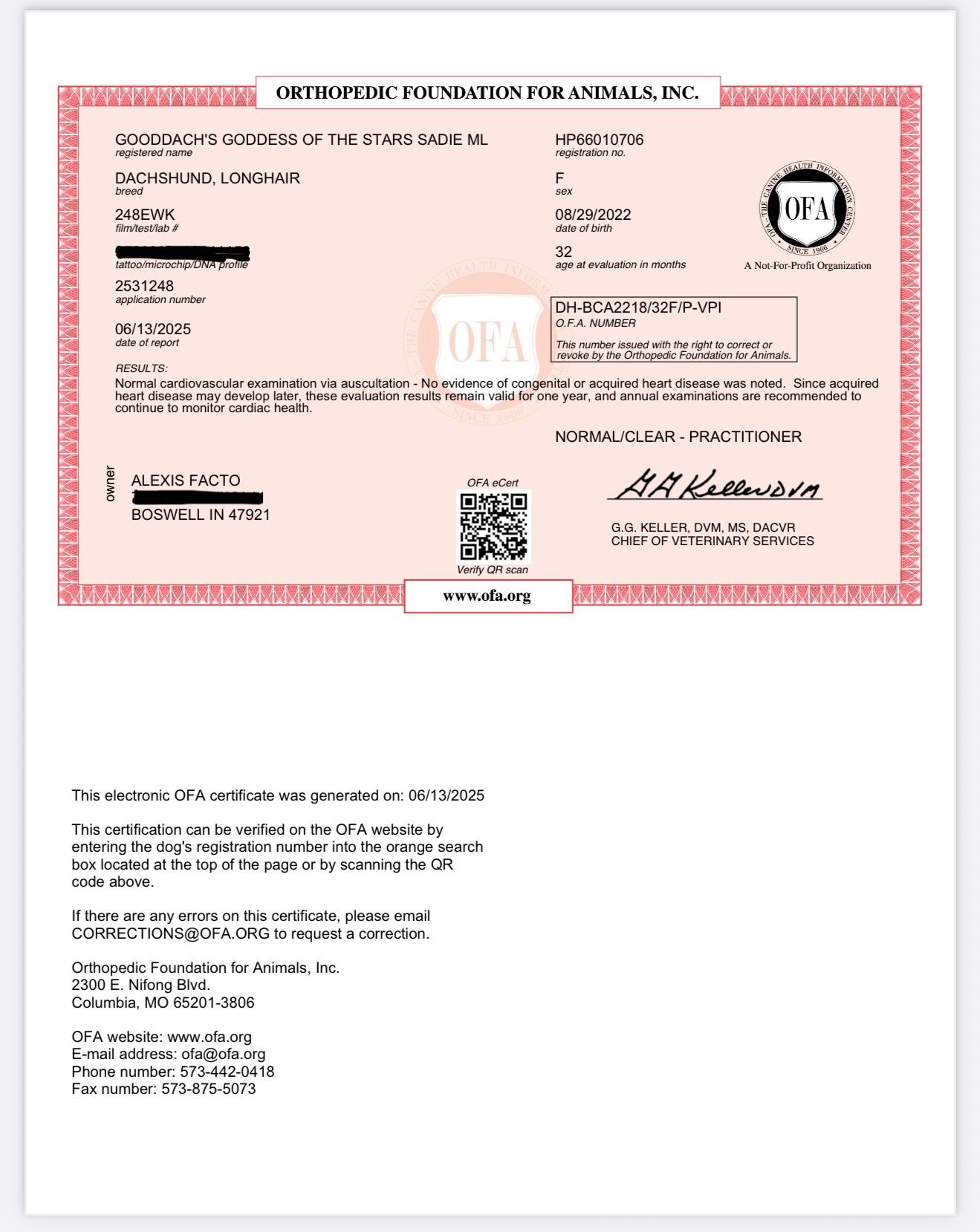
The OFA - CHIC and AKC do communicate. On the registration or pedigree of an AKC bred with H.E.A.R.T. puppy there will be the logo and there should be CHIC/OFA number by the parents names (sometimes it takes a while for this so if it's a dog's first litter don't be too alarmed if these numbers are absent)
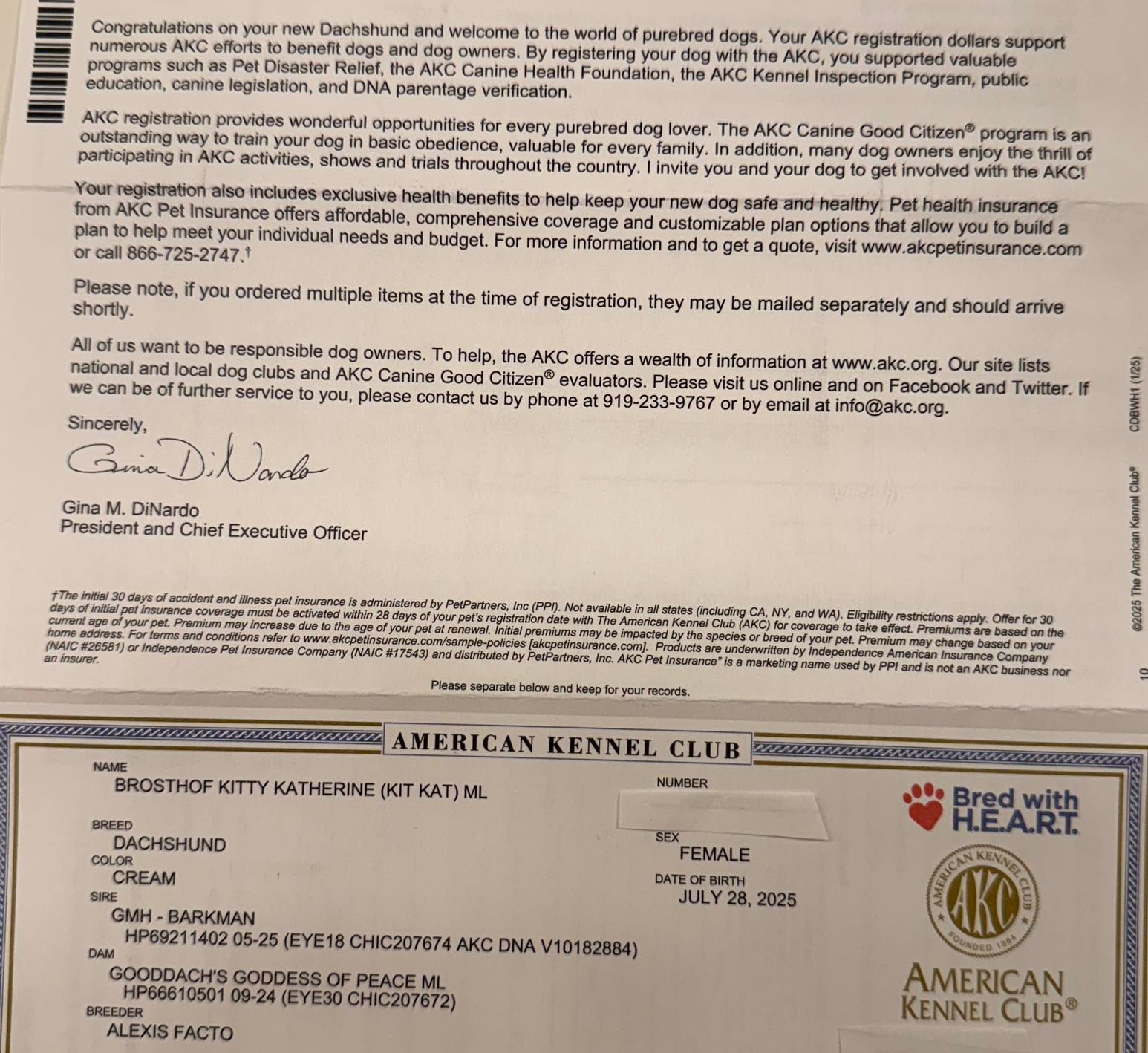

The following applies to any breeder who claims to be bred with H.E.A.R.T or states that they do all of the health testing. If a breeder is openly doing only DNA tests that doesn't immediately mean they are untrustworthy.

RED FLAGS if a breeder says...

(all things I've been told from other breeders before when looking for additions for our program)

By Alexis Facto April 23, 2025
There are hundreds of different coat, color, and pattern combinations when it comes to the Dachshund breed. Beyond that, coat colors develop gradually from when they are a neonate and into adulthood. Since there are so many different combinations, I'm mostly focusing on what puppies we may produce as a breeder and only touch on the others.
By Alexis Facto February 21, 2025
We can accept deposits through our Zelle or our Good Dog account. When we meet in person for pick-up day we can do the remaining amount the same two ways or cash. Please do not make a deposit without speaking with me first to make sure your adoption application has been reviewed. All payments will be followed up with a receipt sent via email. How pay using Zelle: Request a link from me or search using my same phone number from our calls or texts. How to pay using Good Dog: The good dog platform automatically includes payment protection and fees for access to their puppy training library. These are not mandatory fees and do not affect me as the seller. It is at your discretion if you want to incur the added fees, but if you don't want to pay them just follow the instructions below.
By Alexis Facto February 17, 2025
A guide to the items you need, didn't know you need, and will want to have as your new puppy grows.
Canine Vaccinations
By Alexis Facto January 24, 2025
When puppies are born to a healthy, vaccinated mother, their mom’s colostrum provides antibodies that give them passive immunity from diseases during early life. The length of time that this immunity lasts isn’t a set amount of time and varies greatly depending on mom’s level of immunity as well as the specific disease. Vaccine schedules are variable but the goal for all is to try and time the puppy’s initial vaccination with when they are most likely to lose their passive immunity but without overlapping that passive immunity—and definitely before they’re exposed to any life-threatening diseases. Puppies who are vaccinated while they still have passive immunity won’t gain new or more immunity, but it would just render that vaccination ineffective as though nothing had been given at all. For these reasons, the initial core vaccine is given somewhere between 6 and 8 weeks of age with enough boosters following that over the course of a few months. This many vaccinations is considered completely safe and essenti
By Alexis Facto November 1, 2024
Back disease in Dachshunds is by and large a genetic issue. All dachshunds are genetically predisposed to be vulnerable to back disease. And in order to keep the focus of this blog on things that we CAN control this section will be brief. There is not yet a reliable genetic test that can help breeders decrease the risk. Right now the best thing we can do is breed dogs who do not show signs of back disease, keep up to date with the latest research, and cross our fingers that in the future scientists can pinpoint the issue and generate a definitive test.
By Colt Dodd, AKC June 16, 2024
Please follow the link to read more about AKC's new research on spay & neuter age.
By Alexis Facto March 2, 2023
I do longer do formal temperament testing--it takes a huge amount of time & organization and my puppy's results have always been in the mid-range. If I ever have a puppy I suspect to be an outlier I will perform some testing so I can find him or her the right fit.
By Alexis Facto March 1, 2023
A personal backstory: My first dog that I owned as an adult was a female black lab mix. She was the most amazing, loving dog but as she turned one and started becoming a true adult dog she began to show really bad signs of aggression toward other dogs. I was devastated and admittedly clueless as to how or why this was happening. Sadly, I've heard so many of the same stories from others who have or had a great dog, but...they're food aggressive, or they can't take them around other dogs, or they're fearful to have them around their children. And I'm not one to judge from who, where, or how they acquired their puppy at that time. I'm far from a great example of finding a reputable dog breeder--I got my black lab mix for $150 from a woman I found through craigslist. She was kind and the puppy was healthy but I didn't know any better, I was 18 years old. I firmly believe that had I done my research and found a dog that I knew had received even a small level of ENS or early socialization I would have avoided this situation. Could something have happened later in my dog's life to make her aggressive? Sure, I'm not trying to skirt blame, however, had she been raised following the puppy culture program I believe that whatever spooked her or created this fearfulness would have been mild in her mind and she would have psychologically moved past it rather than holding onto it and allowing it to grow. Creating a healthy response to the unknown or different is the exact foundation of the puppy culture program. My personal experience was the very reason I wanted to look deeper into how I can do my part as not only a dog owner and most especially when raising puppies so that they have a solid start in life and avoid developing any unwanted behaviors or idiosyncrasies. So with that in mind, here is a more in-depth look into the puppy culture program that we have adopted for whelping and raising our own puppies. Prenatal: Before Puppies are Born While this program mostly encompasses exercises for the puppies it actually starts with the dam (mom). Having a healthy dam who receives adequate exercise, attention, and a healthy diet is the most basic starting point for producing quality puppies. Our dams are fed Purina Pro Plan as well as specific supplements that are beneficial to pregnant dams and Dachshunds. Also, at the most basic level we make sure that they are current on all of their vaccines & dewormings. Neonatal: 3 - 14 Days Old For the first two weeks of life is when we implement the five Early Neurological Stimulation (ENS) exercises. These include tactile stimulation, 3 positioning exercises (supine position, head up, and head down), and thermal stimulation. Each exercise is only done for a few seconds each time daily but sets the scene for what comes in the following weeks. Puppies are born both deaf and blind so by handling them in these specific ways early in life helps them adjust when additional senses are added as they grow older. We've personally noticed that it helps later for puppies to have their nails trimmed, to lay relaxed on their backs, and not spook when they see a big hand coming their way in the whelping box--which I would imagine that could be quite scary if not properly introduced. Transitional Period: Approx. 2 Weeks Old - 3 Weeks Old This period occurs between the time that they open their eyes but before they begin to react to sounds. Their eyes typically open around the 2 week mark but can vary for each litter and each individual puppy. During this time puppies still sleep a majority of the time but also begin to do vocalizations and interact with their littermates. Critical Socialization Period: 3 Weeks - 12 Weeks Old There are seven key concepts that need to be covered during this critical socialization period: Communication, Emotional Stability, Habituation, Enrichment, Health, Skills, and Love. 1. Communication: teaching the puppies how to respond to a clicker, playing the box game to condition the puppies to the stimulus, and manding (sitting for attention). Jane calls these the communication trinity. 2. Emotional Stability: creating a safe environment but introducing something that mildly startles the puppy so they can calmly recover and challenging them with a barrier that they have to both mentally and physically get past. 3. Habituation: This is likely what most people think of when they hear socialization but it's just 1 out of the 7 concepts we need to touch on for this program. Habituation refers to familiarizing the puppies with a variety of different stimulus: from noises to smells, sounds, objects, animals, and people. 4. Enrichment: Create within the home, and safe adventure to areas experiences that inspire enrichment for the puppies. While exercise is important, it's equally as important to challenge their brains and promote learning and problem-solving. We do this at home by utilizing baby toys that we find at the used children's store and utilize our own property for additional adventures. On 5+ acres and with many different animals species, children, and visiting family members we're lucky that we can provide for the puppies here without venturing out far. However, car rides are an important part of this experience too so we dabble that in as well. 5. Health: We keep records of puppy's weight gain, stay on schedule with deworming's, vaccinations, nail trims, and begin grooming (including light blow drying). Our puppies also visit our veterinarian Dr. Lisa Morris at Oak Grove Veterinary Clinic before going home. 6. Skills: We introduce crates/kennels very early by allowing them free access to one in the whelping box, we also practice leash walking, potty train them to go on trays within their whelping box, work on simple commands if over 10 weeks, and keep practicing our manding. 7. Love: While this sounds obvious, the 'love' portion of the program is more than simple cuddles--although that's important too. It involves creating positive experiences for the puppies emotionally so that they find comfort and contentment in the company of both people and other dogs (cats too at our home). There are a variety of conditioned emotional response (CER) techniques that can be used but it varies from puppy to puppy on where they are at as individuals. For example, if a puppy is having emotionally seeing other dogs as a positive that can be worked on by using positive reinforcement and repetition. After 12 weeks of age the critical socialization period closes but puppy culture has much more material and resources you can use for not only our puppies when you take them home but older dogs as well. If you want to learn more, their website is https://shoppuppyculture.com/ and be sure to check out their blog posts on their partner website https://madcapuniversity.com/blogs/articles-and-product-reviews If you get a puppy from us I will also send home a couple page guide with some methods you can implement from 8 - 12 weeks.